Free dinosaurs printable
4 Easy Dinosaur Coloring Games for a Family Table
Four original free dinosaur PNGs become partner games: color caller, mystery detail, color memory and a picture-story relay. Choose an easy or extra challenge on each page.
A shared coloring table can be awkward when one child wants a clear instruction and another wants to invent everything. These four dinosaur games give each person a different job on the same picture. One chooses while another colors, one gives a clue while another finds it, or everyone adds one little piece of a story. You can play together without asking everyone to work at the same speed.
Each game has its own original free black-and-white BoysColor PNG below. There are four files, not a single four-page PDF. Start with just one sheet. Every activity includes an easy way to join in and an optional extra challenge; the choices are not age tests. Pointing, naming a color or making one mark can count as a complete turn.
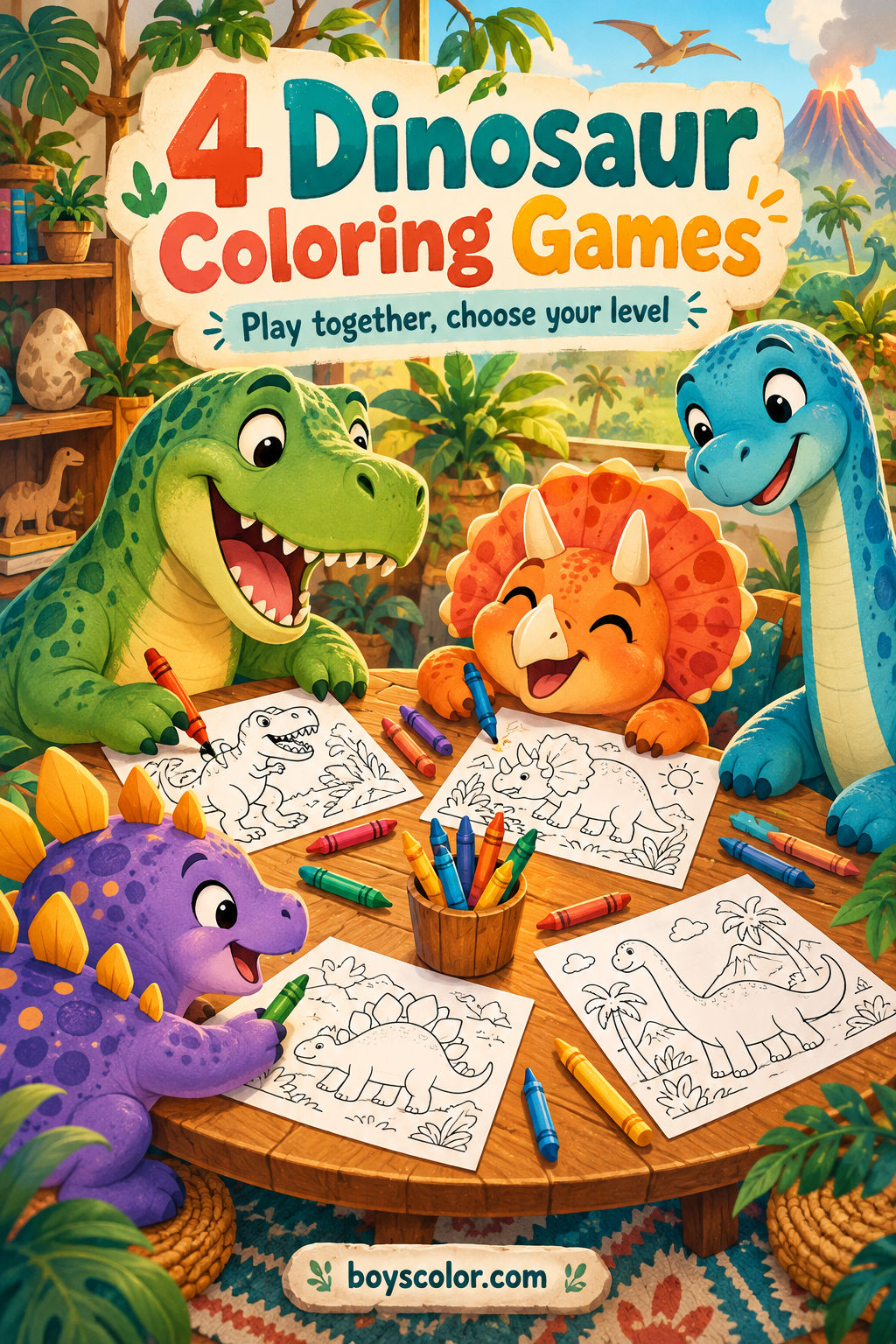
These are cooperative table games with no score, timer or printed answer key. They differ from our earlier dinosaur play-ideas collection: the main task here is taking different partner roles, not completing an egg hunt, footprint pattern or habitat scene. The colorful cover is an illustration of the idea, not a fifth printable or a result to copy.
Set up one shared page and flexible turns
Use crayons or colored pencils, a plain sheet to cover a picture if wanted, and one printed game page. Two people can share one page; a bigger family can take turns around it. Give each person room to reach without leaning across someone else’s drawing. No cutting, dice, game pieces or special supplies are needed.
Print the PNG in portrait orientation and choose Fit to page for Letter or A4. These image files are not pre-sized PDFs. Check the preview so the picture stays inside the printer margins. Keep the outlines at their normal proportions rather than stretching the dinosaur to fit the paper. Print a second copy only if someone would prefer a separate sheet.
Before starting, agree that the person coloring may decline a suggestion. A caller offers a color; they do not control someone else’s picture. Let a child use the easy choice on one turn and the extra challenge on the next. If speaking is not comfortable, pointing to a color or a visible shape works. An adult can model the first exchange without turning it into a quiz.
- Choose one game rather than laying out all four at once.
- Explain the two roles with one short example.
- Let each person finish a small turn, then swap roles.
- Stop after everyone has joined in, or repeat if the group wants more.
1. Color Caller: choose for a partner
The large triceratops gives partners plenty of room to make different color choices. The empty circles above it can hold quick color swatches. They are not a numbered key, and the picture has no correct color solution. Leave the circles blank if choosing directly from the pencil box is easier.
One person is the caller and one is the colorer. The caller chooses a color and points to one broad part, such as the frill or body. The colorer agrees, colors a little of that area and then offers a choice on the next turn. Swap roles before anyone has to finish a large shape. This is a partner-choice game, not a race to fill the page.
Easy choice or extra challenge
Easy: put two crayons on the table. The caller points to one and then points to a part of the dinosaur. The colorer can make just a few strokes. If sharing the same page feels uncomfortable, print two copies and exchange suggestions without exchanging pictures.
Extra: the caller offers a color and a reason: “Could the frill be orange because this dinosaur is ready for a parade?” The colorer may accept it or suggest another idea. The reason can be entirely imaginary. Nobody needs to know dinosaur names, real body colors or prehistoric facts to play.
- Choose or mark a color swatch.
- Offer one color for one visible area.
- Color a small part, then exchange the caller and colorer roles.

Download this free printable (PNG)
Ask your child: Which color would you like your partner to try, and can they suggest one for you?
2. Mystery Detail: give a clue, find a shape
Two different dinosaur silhouettes give the clue-giver something clear to describe. Choose one detail that is actually visible: a long neck, a back plate or a tail. Look together before playing so nobody has to guess an object hidden outside the picture. These are cartoon shapes, not a test of species identification.
The clue-giver quietly picks a visible part, describes it without pointing, and waits. The finder points to the detail they think was chosen. The clue-giver confirms or adds a clearer clue; then the finder chooses a color for a small area there. The chosen detail is the answer for that turn, so there is no separate solution sheet.
Make the clue fit the person listening
Easy: show two possible places first and give a simple clue, such as “I mean the long neck.” The finder may point without saying anything. If they choose a different place, explain what you meant and let them choose the next clue. Do not take away a turn for a misunderstanding.
Extra: use two visible clues without naming the dinosaur, such as “It is tall, and it curves above the other dinosaur.” Choose a part for which both clues fit the actual drawing. If more than one answer seems reasonable, accept the interpretation or revise the clue together rather than insisting the picture is unambiguous.
- Pick one clearly visible detail.
- Describe it and let a partner point.
- Confirm together, color a small area and swap roles.

Download this free printable (PNG)
Ask your child: What clue could help someone find your chosen shape without your finger showing the way?
3. What Changed? a color-memory turn
This sheet starts completely uncolored. The armored dinosaur and simple nearby objects offer several easy places to add one new color. There is no printed before-and-after pair, missing-object puzzle or hidden answer. The change is something a person at your table makes during the game.
Look at the page together. One person looks away or holds a plain sheet over their own view while the other adds color to one previously blank area. Keep the printed picture flat on the table. When the partner looks again, ask what changed. Point to the new mark together, then swap roles. The correct answer is the area just colored, not a detail from a fixed answer key.
Keep the difference friendly and visible
Easy: let the partner watch the coloring and point to the new color afterward. On another turn they can look away for a moment if they want. A broad area of a bright color is easier to notice than one tiny pencil stroke. Help openly if finding it stops being enjoyable.
Extra: preview the partly colored page, look away and let the other person color one new area. Keep each turn to one change rather than quietly adding several. Once many spaces are colored, end the game or start a fresh copy; a crowded page should not become a harder test somebody has to pass.
- Look together at the current state of the picture.
- Add color to one new area while the partner watches or looks away.
- Find the new color together and exchange roles.

Download this free printable (PNG)
Ask your child: Which one area changed on this turn?
4. Picture Story Relay: build one little adventure
The picnic scene is a starting point for a shared story, not a finished sequence that everyone must retell. The empty bowl and open parts of the cloth leave room for one invented food or object. Partners can also stay with coloring if drawing an extra item does not appeal.
Go around the table. Each person adds one color or a small drawn detail and contributes one short story piece. Someone might color the bowl purple and say, “They brought purple berry soup.” The next person could add a leaf umbrella and say, “Then the rain began.” Accept surprising contributions and build on them instead of replacing the previous person’s idea.
Give different contributors equally useful roles
Easy: point to a color or name one thing in the picture. An adult can turn that contribution into a short sentence without changing its meaning. A person who does not want to draw may be the narrator, while someone else adds the agreed color. Passing a turn is allowed.
Extra: connect a new contribution with “then” or “because,” so the story responds to what is already there. Add only one small idea at a time; do not require a paragraph. Finish after everybody has contributed, and let the group choose whether to give the picture a title. There is no need to complete every white area.
- Choose who will begin and which direction turns will go.
- Add one color or detail and one small story contribution.
- Let the next person build on it, then finish when everyone has joined in.

Download this free printable (PNG)
Ask your child: What could happen next that uses something another person added?
Finish while it still feels like shared play
A round can be complete after each person has had one turn. Keep an unfinished page for later, display it as shared artwork or let someone continue coloring alone. The partner game does not need to occupy the whole afternoon to have been worth setting up.
If the children want incompatible rules, offer separate copies or let them choose different roles rather than forcing one difficulty level. These activities are flexible play ideas, not assessments or a promise of a developmental result. A quiet color choice and an elaborate spoken clue can both belong at the same table.
For a different session, our earlier five-page dinosaur play collection has individual picture prompts. There is no need to add those today. One page on which everybody contributed something can be a satisfying finished family project.
🦕 More dinosaur coloring collections
12 hand-picked coloring page sets on the same theme.