Free halloween printable
Halloween Color-and-Count: 4 Friendly Printable Games
Four original free Halloween counting PNGs: tally pumpkins, color a chosen number of ghosts, compare bat groups and combine two hat groups. Includes checked answers and parent tips.
A counting activity can start with one small decision: touch each pumpkin, choose three ghosts or notice which group has more bats. These four free BoysColor games put a different counting action on each page. The pictures stay friendly and the groups stay small, so you can begin with one sheet rather than presenting a whole packet.
The four tasks are tallying a set, selecting a requested quantity, comparing two groups and combining two groups. There is no timer or required age. Pick the action your child is comfortable trying, read the prompt aloud if needed and let coloring remain part of the play. A child who only wants to color can use the same drawings without answering the questions.
Every black-and-white worksheet is an original PNG with its own free text download link below the image. The colorful market cover is decorative, not an extra counting sheet. The optional Creative Fabrica product is a different creator’s collection and is not needed for any of these four games.
Choose a counting action before choosing colors
Print one PNG on Letter or A4 using Fit to page and check that the bottom caption is visible. Put out a pencil and a few crayons or coloring pencils. No scissors, loose counters, die or extra worksheet is required. Covering the lower half of a sheet with scrap paper can help when you want to look at only one group at a time.
Ask whether your child would like to count everything, choose a few characters, compare groups or put two groups together. Point to the exact objects being counted. Pumpkin leaves, bat wings and hat bands are parts or decorations, not extra members of the set. Invite one touch per object; a small pencil dot beside each counted object can make a recount easier.
Writing numbers is optional. A child can say the answer, make dots or ask an adult to record it. If the first answer differs from a recount, look together from left to right instead of treating the page as a test. Finish one action before adding an extension. The answer notes below let the grown-up check the picture without revealing the result at the start.
- Choose one sheet and read its short instruction.
- Point, count and make the requested choice before coloring.
- Record an answer in words, marks or numerals, then color as much as wanted.
1. Pumpkin Tally: give every pumpkin one mark
The page contains five whole pumpkins: two in the upper row and three underneath. Ask your child to touch one pumpkin, make one mark in the My Marks area and then move to the next pumpkin. Straight strokes, dots or small circles all work. The useful rule for this round is one mark for each pumpkin, not a particular style of tally notation.
After the first count, match each pumpkin to a mark by pointing back and forth. If two marks seem to belong to one pumpkin, erase one or start again on scrap paper. This makes the check visible without needing a speed goal. Color the pumpkins afterward; each can have its own palette or the same favorite shade.
Answer check: five pumpkins and five matching marks. The leaves around the group are not pumpkins and do not belong in this total. For an easier version, cover the bottom row and count the first two before revealing the other three. For another round, count from the opposite end and see whether the total changes.
- Touch a pumpkin and make one mark in My Marks.
- Continue until every pumpkin has one mark.
- Count the marks, record five if wanted and color the pumpkins.

Download this free printable (PNG)
Ask your child: How can you tell that every pumpkin has exactly one mark?
2. Ghost Guests: choose three from a group of six
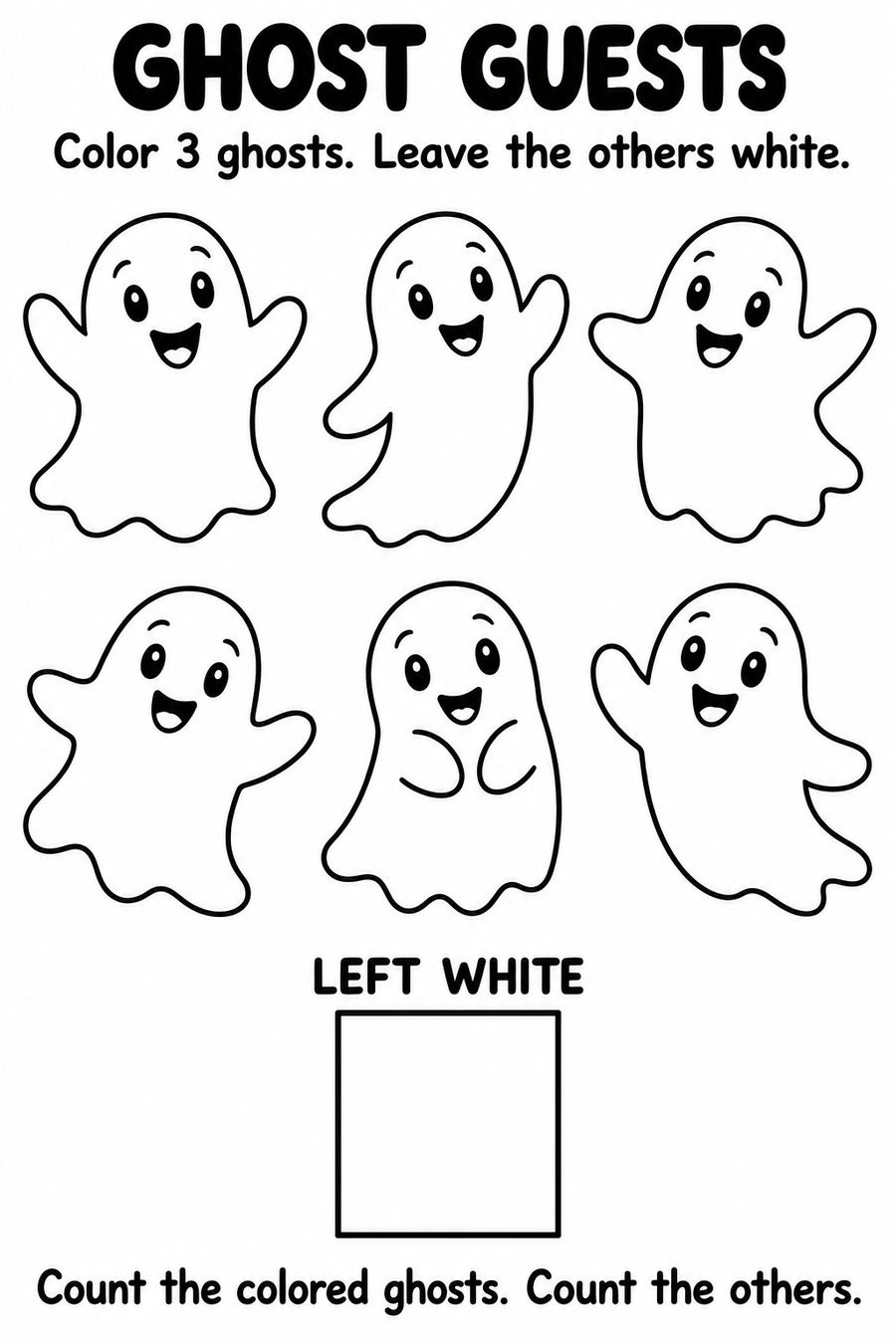
Six friendly ghosts are waiting on the page. The instruction asks the child to color exactly three and leave the rest white. Let them choose any three, rather than requiring a particular row. Lightly point to the chosen guests before filling them in. A small patch of color in each selected ghost is enough to keep the choice visible while the child checks the count.
Now look only at the ghosts still white. Count those and use the Left White box for the answer. This task differs from counting everything: the child first makes a set of a requested size, then notices the remaining set. Coloring all six is fine as a separate art round, but record the counting answer before changing the white group.
Answer check: three colored ghosts and three white ghosts, six altogether. Different choices of three ghosts are equally valid. If selecting three is too much today, an adult can point to three while the child colors them. An extension on a fresh copy is to choose two and find how many stay white; explain the new rule aloud because the printed instruction still says three.
- Choose three ghosts and give each a little color.
- Check the chosen group, then finish coloring those three.
- Count the ghosts left white and record three in the box.
Download this free printable (PNG)
Ask your child: Would choosing a different three ghosts change how many stay white?
3. Bat Groups: compare two sets without a size trick
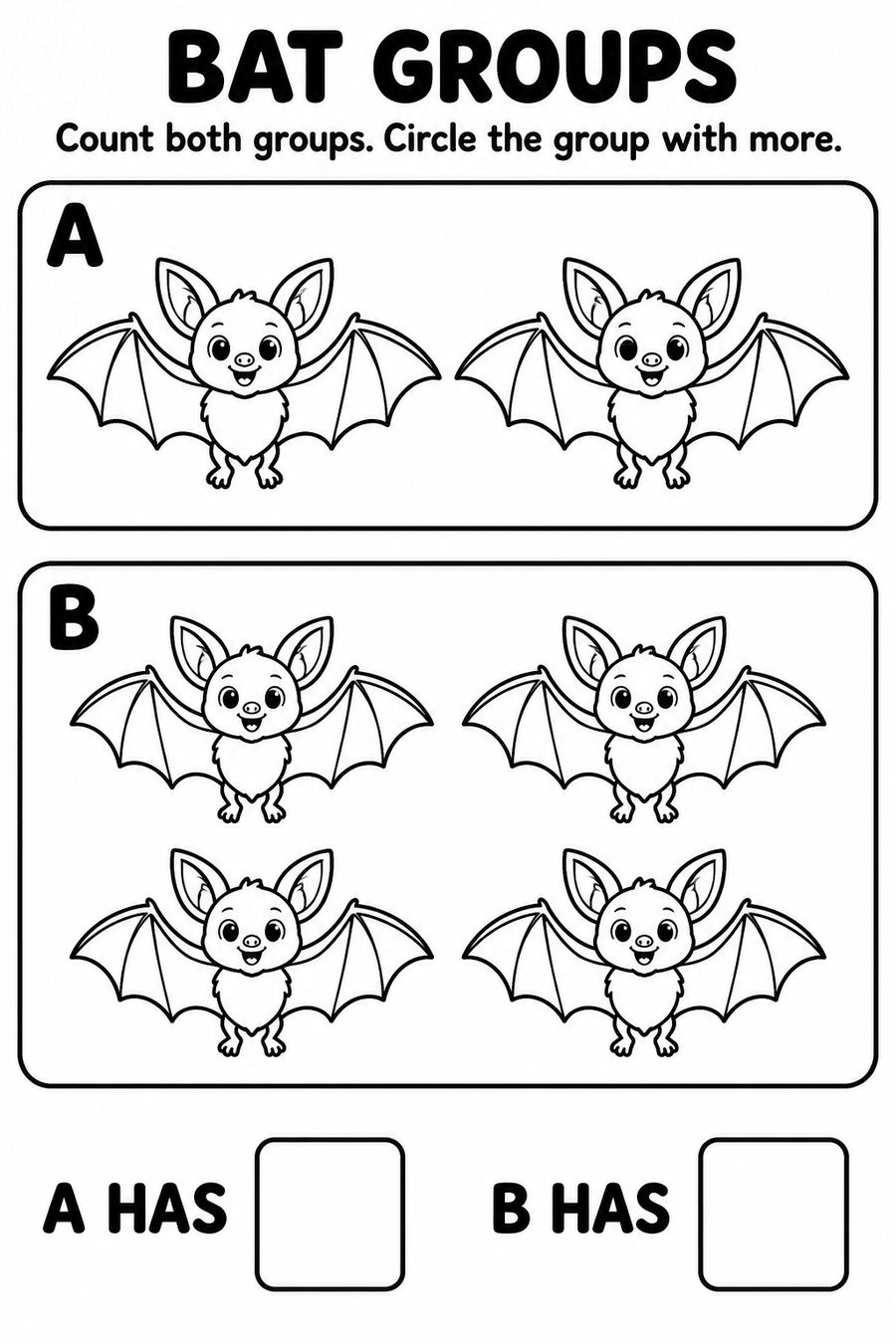
Group A has two bats and group B has four. Count complete bat characters, not their wings. Write or say the total for each frame, then circle the frame with more bats. Because the pictures are separated into labeled groups, your child can return to one group without searching through a busy Halloween scene.
For a second way to check, point to one bat in A and one in B as a pair, then make another pair. Group B still has two bats without partners. You can explain the comparison with words such as more, fewer and the same without requiring written comparison symbols. After choosing the larger group, color both groups however the child likes.
Answer check: A has two, B has four, and B has more. There are two more bats in B than in A. Keep that last question optional; deciding which group has more already completes the printed game. To reduce the task, count A together and let the child try B before comparing.
- Count the bats in A and record two.
- Count the bats in B and record four.
- Circle group B, then color either or both groups.
Download this free printable (PNG)
Ask your child: Can you match bats in pairs and show which group has some left over?
4. Hat Party: put two groups together
Two costume hats are shown in the upper frame and three in the lower frame. Tell a tiny story: two guests have arrived, and three more are on their way. How many hats are ready for the whole party? The blank boxes at the bottom can record 2 + 3 = 5, but saying the groups and total aloud is enough.
Begin by counting each frame separately. Then count all the hats once, moving from the upper frame to the lower one without starting again at one. If counting on from two is comfortable, try three, four, five for the lower group; otherwise recounting all five is a useful complete solution. Do not require a faster method before the child is ready to use it.
Answer check: two plus three makes five hats altogether. There are no hidden hats or hats worn by extra characters. Color the upper set one way and the lower set another if your child wants the two starting groups to remain visible. For an optional story extension, ask how many guests would be ready if one hat were put away, without changing the original printed answer.
- Count two hats in the upper frame and three below.
- Count all five hats together.
- Fill the boxes with 2, 3 and 5 if wanted, then color the hats.

Download this free printable (PNG)
Ask your child: Which hats belong to the first group, and which join them?
Keep the answer separate from the artwork
The checked answers are five pumpkin marks; three ghosts colored and three left white; two bats in A and four in B, with B having more; and 2 + 3 = 5 hats. These notes refer to the unaltered printable groups. If a child adds another character or changes the coloring rule, count the new version together rather than forcing it to match the original key.
You do not need to print all four sheets in one session. Save the other actions for another day, or return to the same task with different colors. A child might enjoy recounting pumpkins but prefer an adult to write the numeral. Keep those choices separate: counting, writing and coloring do not have to be completed by the same person.
For a different kind of gentle seasonal activity, the Halloween Monster Match-and-Color guide asks children to match a character’s body shape. These new pages focus on quantities and groups instead. Neither activity requires the separate product below, and finishing every drawing is not a condition for having played.
🎃 More halloween coloring collections
6 hand-picked coloring page sets on the same theme.


