Free sharks printable
Shark Fact or Fiction? A Gentle Coloring Game
Two free shark coloring game PNGs, four short fact-or-fiction statements, a sourced answer key and a gentle guess-check-color routine.
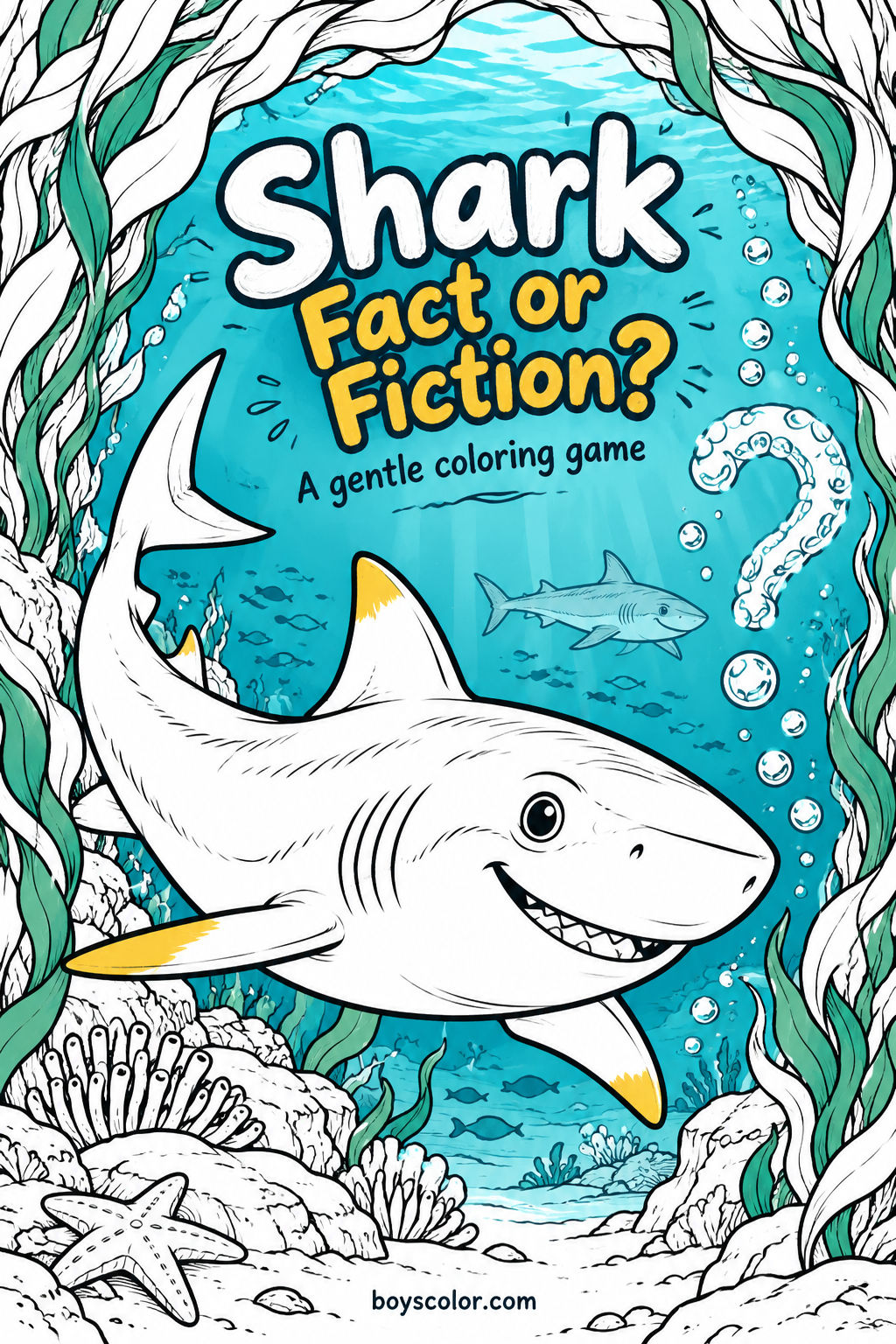
A shark picture can start a small conversation before the crayons come out. In this gentle game, read one short statement, choose Fact or Fiction, check the explanation together, and then color a little of the picture. There is no timer, winner or penalty for changing an answer. Saying “I am not sure yet” is a useful starting point.
The two free BoysColor PNGs below contain four statements in total. The first sheet asks about shark bodies; the second asks about differences among sharks. Each has a coloring illustration and empty answer circles. You can print only the sheet your child wants, read the words aloud, or spread the activity over two sessions.
This is a fact-checking activity, not a species-identification test or a scary shark story. The friendly drawings are cartoons, not scientific diagrams or a size scale. The answer key uses NOAA Fisheries and American Museum of Natural History information linked below. The optional Creative Fabrica book is a separate art product, not the source of these facts or free worksheets.
Set up a guess, check and color round
Set out a printed sheet and a few crayons or pencils. These are PNG image files, not pre-sized PDFs. In the print dialog choose portrait orientation and Fit to page on Letter or A4. Check that the question text and both answer choices stay inside the margins. One test copy is enough before printing for a group.
Explain the two labels first: Fact means the statement agrees with the checked information; Fiction means the statement is not correct as written. In this game “fiction” is a label for an inaccurate statement, not an accusation that somebody has lied. A child can point, circle a choice, or tell an adult which circle to mark.
Keep the answer key nearby but let the child have a first thought. Ask what made them choose that answer, then read the short correction together. If the child would rather color first, let them. The coloring does not have to be earned by getting a question right, and the whole picture can remain unfinished.
- Choose either free sheet and print one copy.
- Read one statement and make a first guess.
- Use the answer key below to check and explain.
- Circle a choice, color a small part, and decide whether to try another statement.
Free sheet 1: Shark bodies
The first page gives a single large shark picture and two short statements. Read them separately rather than asking a child to hold both in mind. The visible fins and gill marks are drawing details; the cartoon is not an X-ray and cannot prove what a skeleton is made of. That question needs a source, not a guess from the outline.
For a short version, use only the first statement, color the shark and save the second for later. For a paired activity, one person reads while the other points to a choice, then swap roles. A reader can help a non-reader without turning the activity into a reading test.
Check 1: “A shark is a fish.” — Fact
Sharks belong to the fishes, not the mammals. AMNH explains this distinction. A whale shark is still a shark and a fish, despite the word “whale” in its common name. For this round, it is enough to remember the fish answer; no species list is required.
Check 2: “A shark has a bony skeleton.” — Fiction
A shark’s supporting skeleton is cartilage rather than bone, as NOAA and AMNH explain. Say “cartilage” together if the word is new, then move on. You do not need to draw internal organs or add pretend bones to the picture. The coloring outline cannot show this hidden feature.
After checking: choose one detail
Invite the child to color one fin, a few bubbles or the largest body shape. The answer does not decide which color is allowed. Gray, blue or an imaginary rainbow can all belong in a cartoon coloring activity. If you want realistic colors, look at a clearly identified real photograph separately rather than treating this generic drawing as a species guide.
- Read statement 1 and choose Fact or Fiction.
- Check the fish explanation, then try statement 2 if wanted.
- Keep or change a guess after reading the correction.
- Color one part of the illustration in any chosen palette.

Download this free printable (PNG)
Ask your child: Which answer needed information that you could not see in the drawing?
Free sheet 2: Different sharks
The second sheet moves from one shark to a wider question about sharks as a group. The two cartoon animals are not drawn to a scientific scale. Use their difference as a conversation starter, not a ruler for comparing real species. The important job is noticing what the words “every” and “some” claim.
Before checking an answer, read the whole sentence aloud. A child may know one example and still be unsure about all sharks. That is an opportunity to slow down, not a reason to make the question harder. You can cover the second statement with scrap paper while discussing the first, then reveal it when ready.
Check 3: “Every shark is the same size.” — Fiction
AMNH describes shark species with a wide range of sizes. One cartoon shark cannot represent that whole variety. The game asks only whether they are all the same size; exact measurements are not needed.
Check 4: “Some sharks lay eggs.” — Fact
AMNH explains that egg laying occurs in some shark species, while others give birth to live young. “Some” is important: this does not say that every shark lays eggs. The worksheet is not a diagram of a particular species or its egg case.
Try a word swap without another worksheet
Once the checked sentence is understood, ask what would happen if “some” became “every.” Keep this as a discussion, not an extra printed question with an unlisted answer. Let the child explain in their own words why a statement about one animal may not describe a whole group. An adult can model changing their mind too: “I guessed first, then checked.”
- Read each entire statement, including every or some.
- Point to a first choice without racing.
- Check the explanations and change a choice if needed.
- Color the two sharks differently or give them a shared palette.

Download this free printable (PNG)
Ask your child: How would changing the word some to every change a claim?
Finish with curiosity rather than a score
The complete answer order is Fact, Fiction, Fiction, Fact. That key applies to these four printed sentences in this order, not to every statement someone might make about sharks. If a child asks a new question, write it on the back and look it up together rather than inventing an answer to keep the activity moving.
For a small group, give each child a sheet and let everyone make a private first choice before talking. Invite explanations without ranking children by speed or number correct. A child who changes a guess after checking has used the routine successfully. There is no need to display names, marks or results.
If the questions stop being enjoyable, put the fact game aside and keep the coloring. For a different shark task, our pattern pages explore stripes, spots and waves through imaginative art rather than biology. You do not need to print another page today. One checked idea and a partly colored shark can be a complete session.
Sources for the shark facts
Popular coloring collections
Hand-picked coloring page sets across our most-loved themes.