Free space printable
A Space-and-Robot Coloring Adventure for a Weekend
Turn three original free PNGs into a little space-and-robot mystery: draw a clue, make a guess and reveal a surprise. A flexible coloring story for one child or two partners.
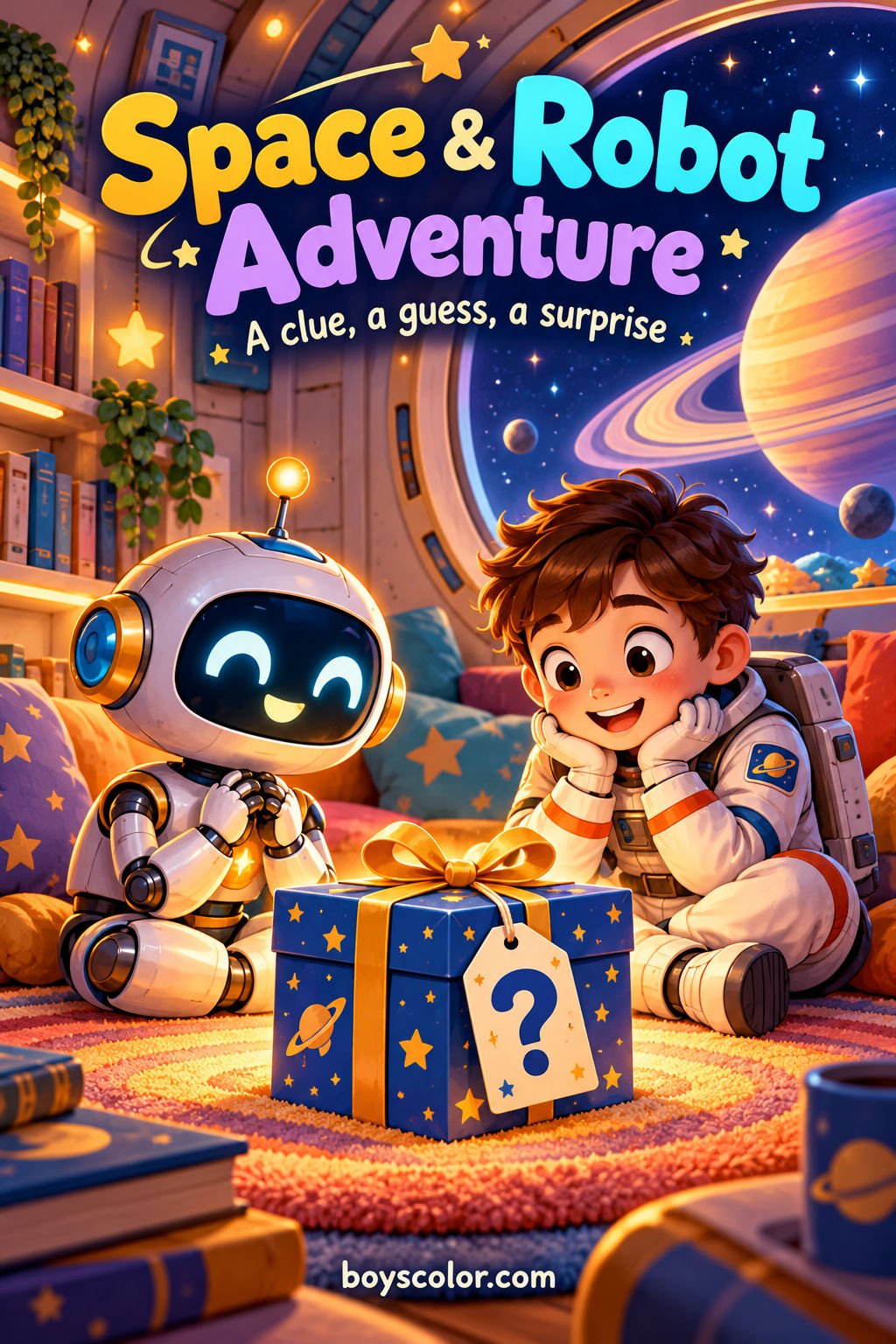
A friendly robot has brought a surprise to an imaginary space station. The astronaut can see the box, but not what is inside. Your child supplies the missing information: a clue on the first page, a guess on the second and a reveal on the third. Coloring connects those decisions into a little mystery rather than three unrelated pictures.
The three original black-and-white BoysColor PNGs are free individual downloads below. Their empty areas are intentional drawing spaces. There is no printed secret answer to discover, no correct route through space and no code to decode. The child chooses the surprise. The colorful cover is an illustration, not a fourth worksheet or a model to reproduce.
Use this as a weekend project with pauses, or enjoy one sheet in a short session. No screen, costume, real gift or physical mystery box is needed after printing. The robot and astronaut are imaginary story friends, and their comfortable room is not a diagram of real space equipment. The optional Creative Fabrica space collection is separate from these three pages.
Choose a storyteller and a curious guesser
Print the PNGs in portrait orientation using Fit to page on Letter or A4. These are image files, not pre-sized PDFs. Check that the heading and lower table legs remain inside the printer margins. Set out a pencil, crayons and a piece of scrap paper. Nothing needs to be cut out or assembled, and no small objects have to be hidden in a box.
For two players, the storyteller quietly chooses one harmless imaginary surprise: a toy moon, a striped sock, a tiny garden or something sillier. Keep the choice in mind or have an adult note it on the back of the first page. The other player is the curious guesser. They may ask a question and change their idea; this is a shared story, not a contest.
For one child, let the child invent both characters’ ideas. They can know what the robot has brought while imagining what the astronaut might think. An adult can voice the astronaut, but should not replace the child’s surprise with a supposedly better answer. Drawing a small symbol, pointing or dictating a sentence can stand in for a detailed picture.
- Choose an imaginary surprise without needing a real object.
- Make one clue on the closed-box page.
- Put a possible answer in the astronaut’s thought bubble.
- Reveal the chosen surprise and tell what changed.
1. Give the closed box one useful clue
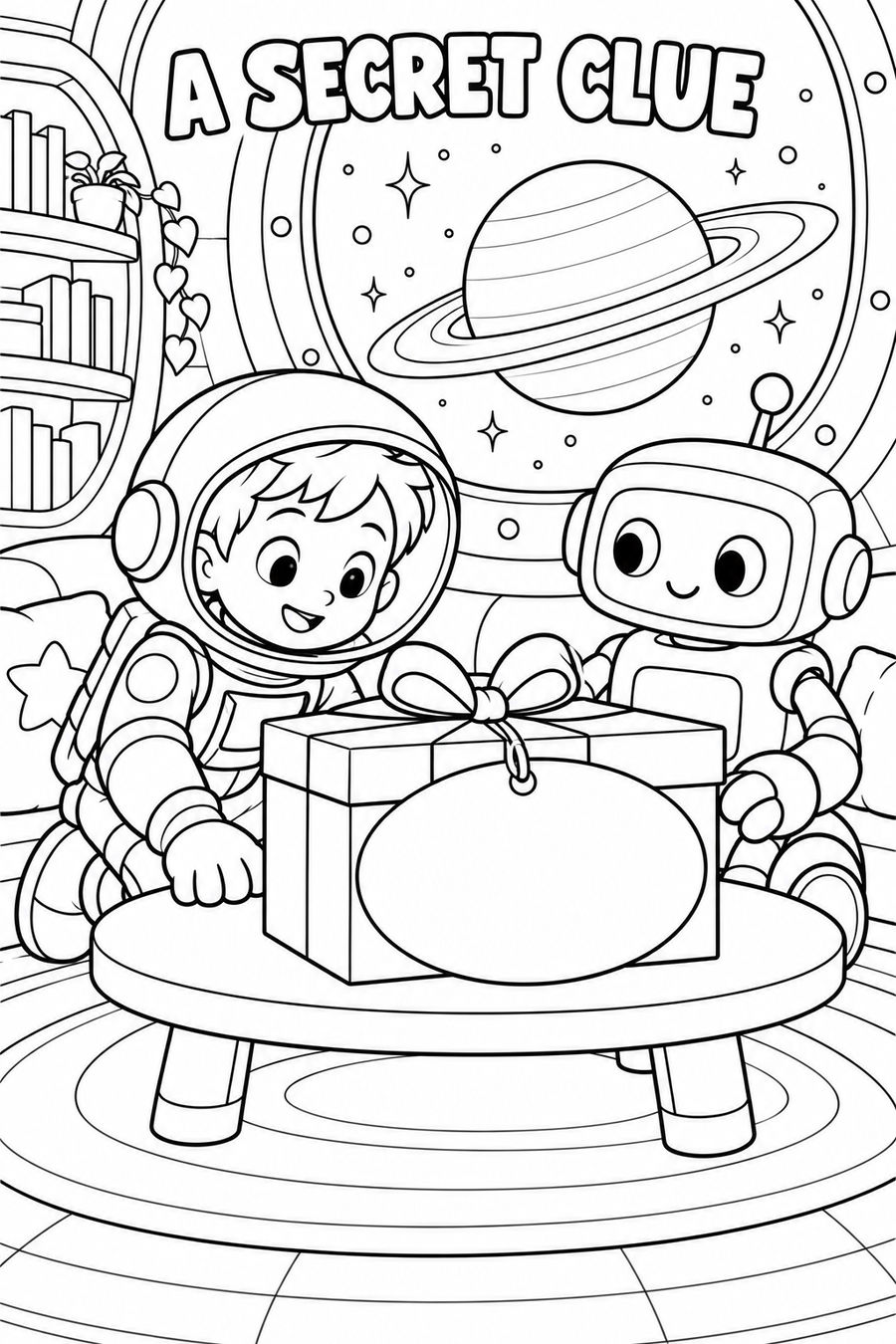
The big oval tag on the closed box is the drawing space. Before coloring the ribbon or the robot, decide what small hint could belong there. A curved line might suggest the edge of a moon toy; a few broad stripes might hint at a striped sock. The clue need not show the whole object, and it does not have to make the answer obvious.
Let the storyteller choose the hint. If the guesser is watching, the storyteller can try a mark on scrap paper first without explaining everything. Then put the chosen mark on the oval tag and color a few surrounding areas. Keep the clue clear enough to point to later rather than covering it with a dark crayon.
A clue can fit more than one idea
A circle could suggest a ball, a moon or a cookie. That is useful room for a story, not a defective clue. Ask the guesser what the mark reminds them of and listen before adding another hint. Avoid promising that one tiny drawing will identify the surprise uniquely. There is no answer key because the secret belongs to the storyteller.
For a small start, choose between two spoken surprises and make one simple mark for the chosen one. For more play, add a short spoken clue about shape or use without naming the object. Keep the original choice the same until the reveal, or openly tell your partner that you want to change the story rather than silently moving the answer.
- Choose the surprise privately or imagine the robot’s choice.
- Draw one partial hint on the blank oval tag.
- Let the guesser describe what the clue suggests.
Download this free printable (PNG)
Ask your child: What can your clue show without giving the whole surprise away?
2. Put a possible answer in the thought bubble
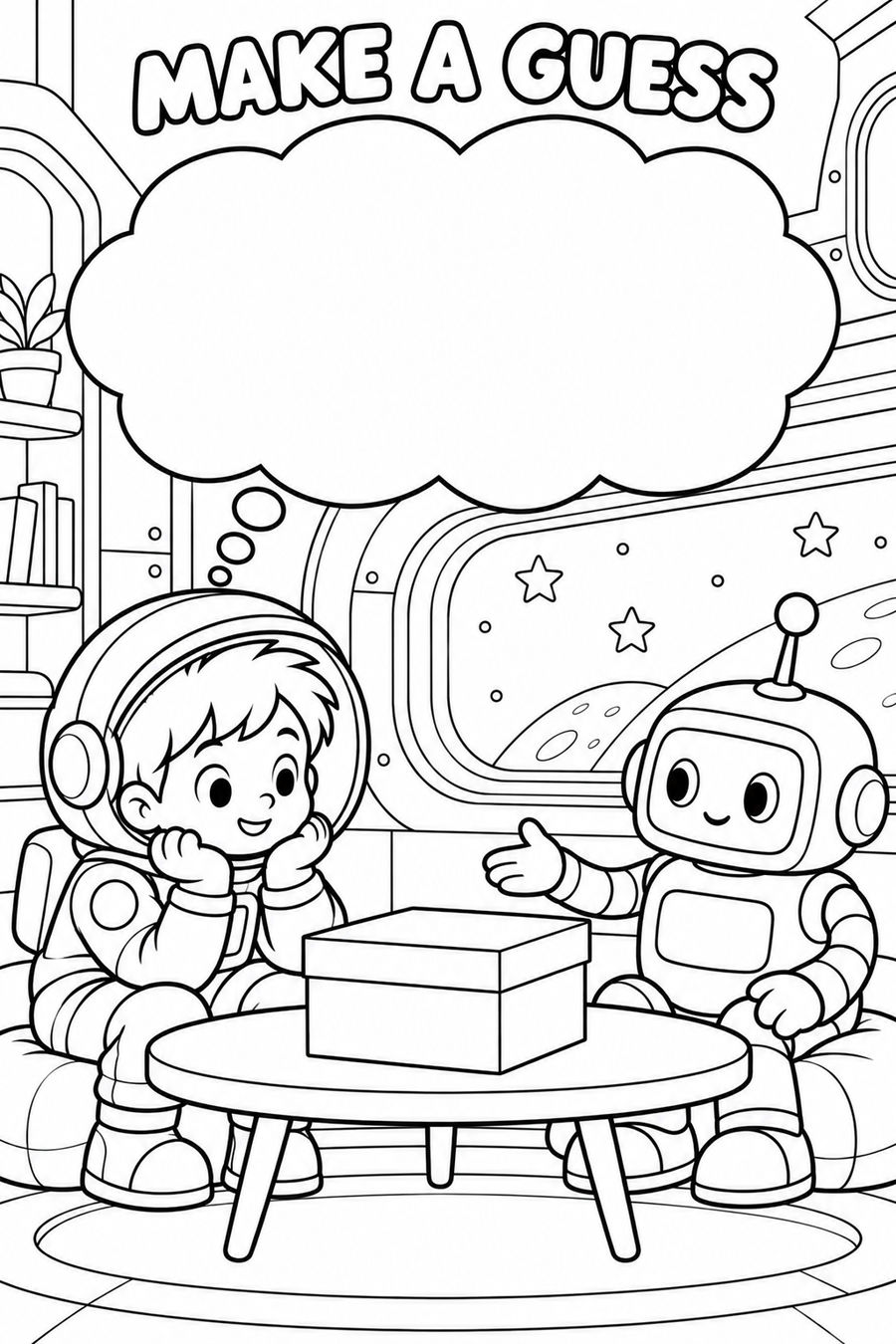
The second page gives the astronaut a large empty thought bubble. Use it for the guess, not for the hidden final answer unless they happen to match. Look back at the first page and name the clue before drawing. A quick outline or a simple symbol is enough to record an idea; no spelling or full sentence is required.
The box stays closed on this sheet. That separates what the astronaut currently thinks from what the robot knows. Let the guesser ask one gentle question such as “Could you wear it?” or “Would it fit on a shelf?” The storyteller can answer in the make-believe world. If the reply changes the guess, add a new idea beside the first one or explain the change aloud.
Keep the earlier thought visible
Do not erase a guess just because it is different from the planned surprise. It will help tell the ending: the astronaut first imagined one thing, then learned something else. A guess that fits the clue is worth discussing even when it is not the storyteller’s exact choice. The useful action is explaining the connection, not earning a point.
For a small start, point inside the bubble while saying the guess and color only the astronaut’s gloves. For an extension, invent two possible guesses and say which clue each one fits. Stop before the bubble becomes crowded. A player may pass or ask for another clue; there is no required number of attempts and no penalty for being unsure.
- Look back at the clue on the first sheet.
- Draw or say one possible surprise in the thought bubble.
- Ask an optional question and explain any changed idea.
Download this free printable (PNG)
Ask your child: Which part of the clue makes the astronaut think of this possibility?
3. Reveal the surprise and connect the explanation
The box is open on the third sheet. Draw the chosen surprise emerging from the open space behind its front wall. A small part can peek out; a tall invented object can rise above the rim. The raised lid is simply part of the box and may stay blank. This is a flat drawing prompt, not a paper box that will hold something real.
Use the choice the storyteller made at the beginning. Then return to the oval clue and point out its connection. If the clue was stripes and the surprise is a striped sock, the explanation can be that simple. If the picture now suggests a better ending, discuss the change together and decide whether to keep the original surprise or deliberately revise the story.
A different guess can still lead to a satisfying ending
Put the guess page next to the reveal. Say “The astronaut thought…” and “The robot actually brought…” Let the child finish the sentences. When the two ideas match, ask what made the clue helpful. When they differ, ask how both ideas could have fitted the hint. Avoid treating the first guess as a mistake that spoils the picture.
For a small start, draw just the top of the surprise and tell what is hidden below the rim. For an extension, choose one thing the friends do with it next: share it, name it or put it somewhere in their imaginary room. No dangerous tools, real experiments or detailed space facts are needed. Color the friends in any palette they choose.
- Draw the chosen surprise in or emerging from the open box.
- Explain how the original clue connects to it.
- Compare the guess with the reveal and invent one next action.

Download this free printable (PNG)
Ask your child: What does the astronaut understand now that was not clear on the second page?
Retell what each friend knew at each moment
Place the three sheets in clue, guess and reveal order. Tell three short parts: “The robot knew…”, “The astronaut wondered…” and “When the box opened…” A child can point while an adult supplies only the connecting words. The pictures do not need to have matching colors or perfectly identical details to belong to the same make-believe story.
If two players want another round, swap roles and use scrap paper for the new clue and guess rather than printing the whole set again. Keep the first version if your child likes it. A second story can reuse the characters while changing the secret. If one sheet was enough, color it freely and save the other pages for a different day.
This activity focuses on clues, possible explanations and a reveal. It is not a test of reading, reasoning ability or emotional understanding, and it does not promise a particular learning result. For a different kind of space play another day, the separate rocket-and-planet guide follows packing, travel and landing. Today the adventure happens between two friends who know different things.
🚀 More space coloring collections
3 hand-picked coloring page sets on the same theme.